Active breakouts and old scarring are two different problems and are treated in that order — calm the skin first, then resurface what the acne left behind.
The single most common mistake in acne care is resurfacing skin that is still actively breaking out. It inflames what is already inflamed, and inflammation is precisely what drives the dark marks patients are trying to get rid of.
So the sequence matters more than the individual treatment. The first phase is about settling active acne and repairing a damaged barrier. Only once the skin is calm does it make sense to work on texture and scarring.
It is also worth separating two things patients often merge. The flat brown or red marks left after a spot clears are post-inflammatory pigmentation, and they fade. True scarring is a change in the skin's texture — indentation or raised tissue — and that needs a different, longer approach.
Excess oil combines with dead cells to block the follicle, creating the closed environment where breakouts begin.
Bacteria present on all skin multiply in that blocked environment, and the resulting inflammation causes both the swelling and the marks left behind.
Hormonal fluctuation drives oil production, while an over-stripped barrier — often from harsh products bought in frustration — makes everything worse.
Which of these applies, and when, depends entirely on whether your acne is currently active. Sequencing is decided at your analysis.
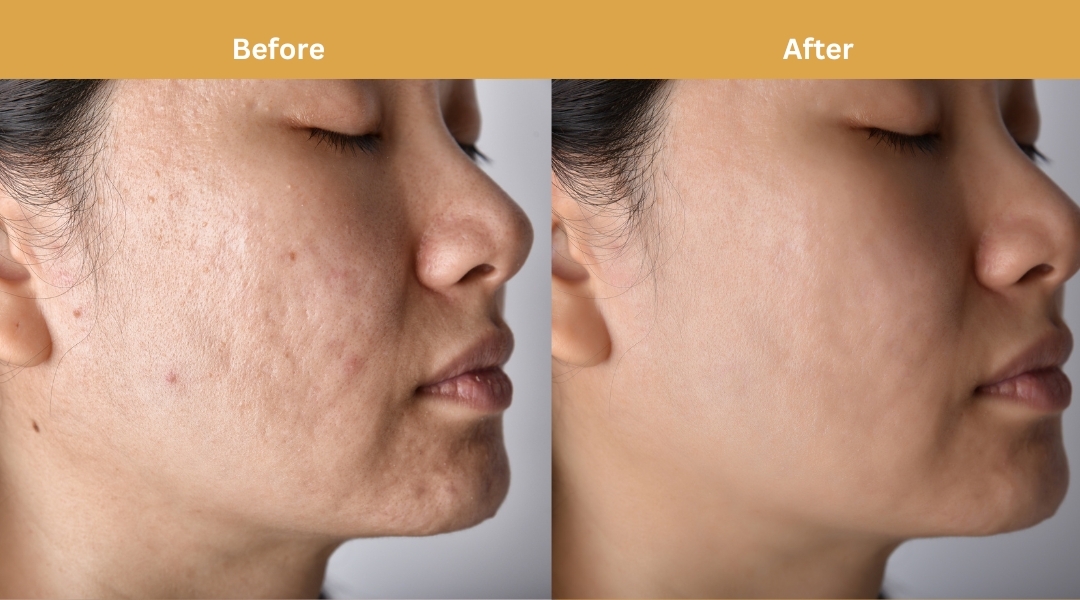
Skin renewal — results shown are from Dermatonik's skin-renewal protocols and may reflect a combination of treatments.
Photographs shared with patient consent. Individual results vary; your clinician will set honest expectations at consultation.
Dr. Saeema Shiraaz assesses whether your acne is currently active, how much is scarring versus pigmentation, and what your barrier can tolerate.
What is appropriate, in what order, and what it will cost is set out before anything begins. You will be told plainly if something is not going to help you.
If your acne is still active, the first phase settles it. Resurfacing is deliberately held back until that point — treating inflamed skin makes the marks worse.
Aftercare is explained before you leave, and we review how your skin has responded before deciding the next step.

Dr. Saeema Shiraaz — cosmetologist, and the reason patients stay. Every treatment plan at Dermatonik is built around her judgement, not a sales target.
Every protocol is planned and supervised by Dr. Saeema Shiraaz — no junior staff experimenting on your skin.
We recommend what works for your skin, not whatever's trending — and we'll say so if a treatment isn't right for you.
Honest timelines, real costs, and no pressure to buy packages you don't need.
They refused to do the laser I asked for until my breakouts settled. Annoying at the time, right in hindsight.
Aditi M.
Acne patient
What patients usually ask before their first visit.
Not if your acne is still active. Resurfacing inflamed skin worsens both the breakouts and the marks. The first phase settles the acne; scarring work follows once the skin is calm.
A dark mark is flat pigmentation left after inflammation, and it fades over time. A scar is a change in texture — indented or raised. They look related but need entirely different treatment.
Often, yes. Adult acne is more frequently hormonal and tends to sit along the jaw and chin, and the barrier is often already compromised by years of harsh products. That changes the approach.
Some routes can cause an initial flare as congestion clears. You will be told if that applies to your plan so it does not come as a surprise.
Almost always. Over-stripping a damaged barrier is one of the most common things we see, and no in-clinic treatment outperforms a routine that is actively working against it.
Scarring responds gradually and across a course rather than in one session. Your clinician will set an honest expectation at consultation rather than promise a timeline upfront.
Tell us a little about what you'd like to address. Dr. Saeema Shiraaz will review your message and the team will confirm a time that works for you.
2nd Floor, 1655, 27th Main Road, opp. NIFT College,
1st Sector, HSR Layout, Bengaluru 560102
By appointment — in clinic or online consultation
Continue the conversation there and the team will confirm your slot shortly.